
Armrest Club.

A fear-of-flying course for nervous flyers

You know the plane is fine. So why are you gripping the armrest?

Armrest Club has you practise at home, a few minutes at a time, weeks before the seatbelt sign comes on.

Ask to try it early Flying soon? Try three breaths now Coming to iPhone, Android and the web
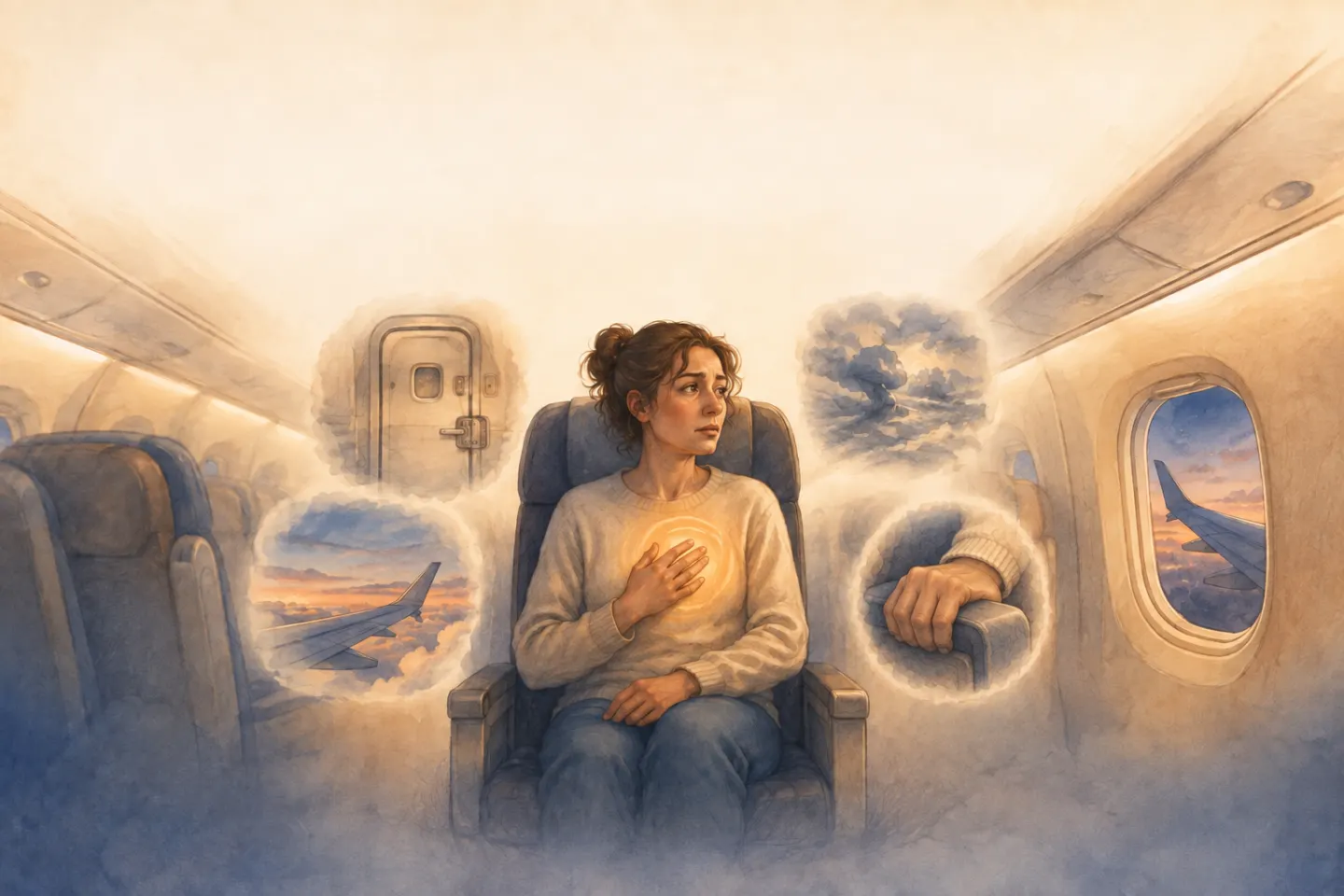
An illustrated passenger in a plane seat with one hand on her chest, surrounded by thought bubbles of a closed cabin door, storm clouds, a wing and a hand gripping an armrest.

You can be a grown adult and still dread a one-hour flight. You don’t have to feel calm to start.

Let’s start with your bit

Which part gets
to you?

Tap yours to see which of the 31 lessons and flight-day guides cover it.

Sound like your inner monologue?

What was that noise?

The engine sound changes, or the plane drops a few feet. You’re reading the crew’s faces while the person next to you is somehow asleep.

In the course

  • Turbulence, DemystifiedHow Flying Works
  • The Soundtrack of a FlightHow Flying Works
  • Taxi and TakeoffFly

What each noise and bump is, and what to do when one still makes you jump.

Those lessons are in the app, which isn’t out yet and has no release date.

Ask to try it early

What you’ve tried

You’ve already
worked hard at this.

  1. More facts

    You’ve read why planes stay up and watched pilots explain every noise. You could recite the odds to the person in the next seat. Then the engines change pitch and your hand finds the armrest anyway.

  2. More checking

    You look at the turbulence forecast again, or search one more thing at 1 a.m. The relief lasts a few minutes, then the question comes back.

  3. More grit

    You white-knuckle it from takeoff to landing, or try a breathing exercise for the first time mid-bump. You land wrung out and start dreading the flight home.

That’s a lot of effort, and none of it is practice.

An illustrated woman at a table by a sunlit window, with an open notebook and a mug beside her.

Train on the ground

It’s hard to learn a new skill
halfway through a bumpy flight.

From the course4 min

Training Beats Willpower

The kettle is on. Your next flight is weeks away. This is a useful time to practise.

Give the skill an ordinary home

When fear is intense, it can be harder to remember unfamiliar instructions. Trying a skill in an easier moment gives you a chance to learn what to do.

A chair in your kitchen is enough. You can begin without waiting for a flight or a perfectly calm day.


Try it now

Three breaths,
right where you are.

This is the course’s long-exhale practice, word for word from the app. It takes about 30 seconds.

An illustrated woman resting by a bright window with her eyes closed, holding a mug.
Train on the ground3 min

The Long Exhale — Your Emergency Brake

Your shoulders rise. Your breathing gets hurried. Give the next breath a little more room.

Let the count serve you

Try about four counts in and six out, only if that feels comfortable. Keep your jaw loose and avoid forcing the last air out.

If counting makes you strain, feel dizzy, or feel unwell, stop and breathe normally. You can simply feel your feet on the floor instead.

Try three easy breaths. Follow the count only while comfortable; you can stop at any time.

Cycle 0 of 3

No account needed. Nothing is recorded.

If you have a flight coming up, do these three breaths a few times before you go, so they aren’t new on the day.Ask to try it early

How Armrest Club works

The course runs in the order
you’ll need it.

Armrest Club teaches you practical ways to steady your body, informed by published research on breathing, fear learning and emotional connection.

Illustrated lessons, guided practice and flight-day guides, all in one app.

  1. 01 · Understand

    Learn why your body still sounds the alarm.

    8 lessons on what your body and mind are doing when you’re afraid, and 4 on what the plane is doing: lift, turbulence, the sounds of a flight and its safety systems.

    Illustrated lessons · Read at your pace

  2. 02 · Train

    Make room to breathe.

    Slow breathing that gives you room to feel afraid and still choose your next step.

    Build an inner sense of support.

    Practise recalling a moment with someone you love, and notice what it does in your body.

    Guided practice · One step at a time

  3. 03 · Fly

    Use your practice on the day, from gate to landing.

    7 short guides, about 2 minutes each, from the week before to the next flight. When the door closes, for example, the guide suggests recalling the moment you practised at home.

    Flight-day guides · Moment by moment

A page from the course

Read two pages
from the first lesson.

It’s from Understand, the first part of the course. Each lesson is a few short pages you can read at your own pace and go back to later.

No account needed to read.

UNDERSTANDREAD A SAMPLE

What fear of flying looks like

Facts can answer question-shaped fear: what creates lift, what turbulence means, what a sound is, or what happens when a system fails.

But a body response can continue after the question is settled. Knowing the facts and still feeling afraid is not a failure to believe them.

1 / 2

Over the weeks

From your kitchen table
to the next flight.

Tap a stop to see how its lesson opens, from the plan you write at home to the flight after this one.

Train on the ground

Assemble Your Flight Plan

5 min

When the day gets busy, a short plan is easier to use. Decide a few responses before you need them.

Later in the course7 min

Tools, Rituals, and Retiring the Props

A breathing practice can help you stay with a moment. It can also start to feel like a rule.

Let support stay available and choice grow.

THE RESEARCH BEHIND THE PRACTICE

Informed by research. Made for practice.

Our exercises draw on published research into emotional connection, fear learning and slow breathing.

These studies help explain why we practise emotional connection, new responses to flight cues and slow breathing.

  • Remembering someone close

    This informs the invitation to recall a moment with someone you love and notice what you feel in your body.

    Thinking of a partner during stressBourassa, Ruiz & Sbarra · 2019

    What it found In a study of 102 adults, having a romantic partner present or bringing them to mind was associated with a smaller blood-pressure response to a stressful laboratory task.

    Its limits Heart-rate and heart-rate-variability responses did not differ significantly. The study did not test flying or measure oxytocin release from a memory.

    University of Arizona · Read the study (opens in a new tab)

  • Learning a new response to a feared cue

    This informs practising connection alongside a manageable flight moment in your imagination. Feeling warmer toward a moment and feeling less fear are different outcomes.

    Attachment imagery and the return of fearToumbelekis, Liddell & Bryant · 2021

    What it found In a laboratory study with 81 participants, attachment imagery before fear-extinction learning was followed by less return of a physiological fear response the next day, compared with positive imagery.

    Its limits There was no corresponding advantage in participants’ reported expectation of threat. This was not a study of flight anxiety or this app’s pairing exercise.

    University of New South Wales, Sydney · Read the study (opens in a new tab)

    A more positive association is not the same as less fearvan Dis and colleagues · 2019

    What it found Across two experiments, pairing a feared cue with something positive improved how people evaluated the cue, but did not reduce the return of fear.

    Its limits This is one reason the practice also encourages continuing with a manageable flight moment when some anxiety remains.

    Utrecht University · Read the study (opens in a new tab)

  • Practising slow, even breathing

    This informs the slow rhythm in the resonance breathing exercise.

    Breathing, heart rhythms and biofeedbackLehrer & Gevirtz · 2014

    What it found This review explains how slow breathing can interact with heart rhythms and the body’s blood-pressure regulation, and discusses possible mechanisms of heart-rate-variability biofeedback.

    Its limits Armrest Club offers guided breathing. It does not measure your heart-rate variability or determine your individual resonance frequency, so it is not the full biofeedback method described in the paper.

    Rutgers–Robert Wood Johnson Medical School; Alliant International University · Read the study (opens in a new tab)

They studied related methods, not Armrest Club. They do not establish how well this programme works or guarantee how you will feel on a flight. Affiliations identify the researchers at publication. They do not indicate university endorsement of Armrest Club.

Inside the course

The whole course,
on one page.

31 lessons and flight-day guides, about 128 minutes of reading in all. Lessons take 1 to 7 minutes, flight-day guides about 2.

Understand

What fear is doing — and why it can change.

8 lessons

  1. What Fear of Flying Looks Like1 min
  2. What Happens When Fear Arises5 min
  3. Why Me?5 min
  4. Two Kinds of Control · Part 14 min
  5. Two Kinds of Control · Part 24 min
  6. How Fear Feeds Itself5 min
  7. The Science UnderneathOptional4 min
  8. Avoidance Feeds the Fear3 min

How Flying Works

What keeps a plane aloft — and what the sounds and systems mean.

4 lessons

  1. Why Planes Fly6 min
  2. Turbulence, Demystified6 min
  3. The Soundtrack of a Flight6 min
  4. The Safety Web6 min

Train

Skills that grow stronger through practice.

12 lessons

  1. Training Beats Willpower4 min
  2. Your Stress Threshold, and How It Grows4 min
  3. The Long Exhale — Your Emergency Brake3 min
  4. Resonance Breathing — Brake Training4 min
  5. Ground Through Your Senses3 min
  6. Find Your Moment of Emotional Connection7 min
  7. Bring Connection into Flight Practice5 min
  8. Fly the Whole Flight in Your Head6 min
  9. Befriend Body Sensations6 min
  10. Possible Isn’t Probable5 min
  11. Tools, Rituals, and Retiring the Props7 min
  12. Assemble Your Flight Plan5 min

Fly

Guidance for the day, from airport to landing.

7 flight cards

  1. The Week Before2 min
  2. Airport and Boarding2 min
  3. Taxi and Takeoff2 min
  4. Cruise and Bumps2 min
  5. Descent and Landing2 min
  6. Land It in Memory2 min
  7. The Next Flight2 min

Questions

Things you might be wondering.

For your next flight, booked or not

Train on the ground.
Then take the trip.

You don’t have to become someone who loves flying to want what’s on the other side.

Join to get emails from Vartna Technologies Inc., which runs Armrest Club, about the app’s launch and invitations to try it early. You can unsubscribe at any time. Vartna Technologies Inc., 1783 Manitoba Street, Vancouver, BC, Canada, admin@vartna.com. Privacy notice

Try three breaths No fearlessness required.

Armrest Club is in development for iPhone, Android and the web.

An illustrated woman with a backpack walking a sunlit path toward the horizon.